New Condo Market: Agent Participation Analysis

Interesting Posts





Below is the 2025 New Condo Market: Agent Participation Analysis, sorted in descending order of Participation %. This analysis focuses on agencies with a significant market presence (at least 5 sales or a substantial agent count) to highlight the most effective organisations in the new launch segment.
Key Insights from the Sorted Data
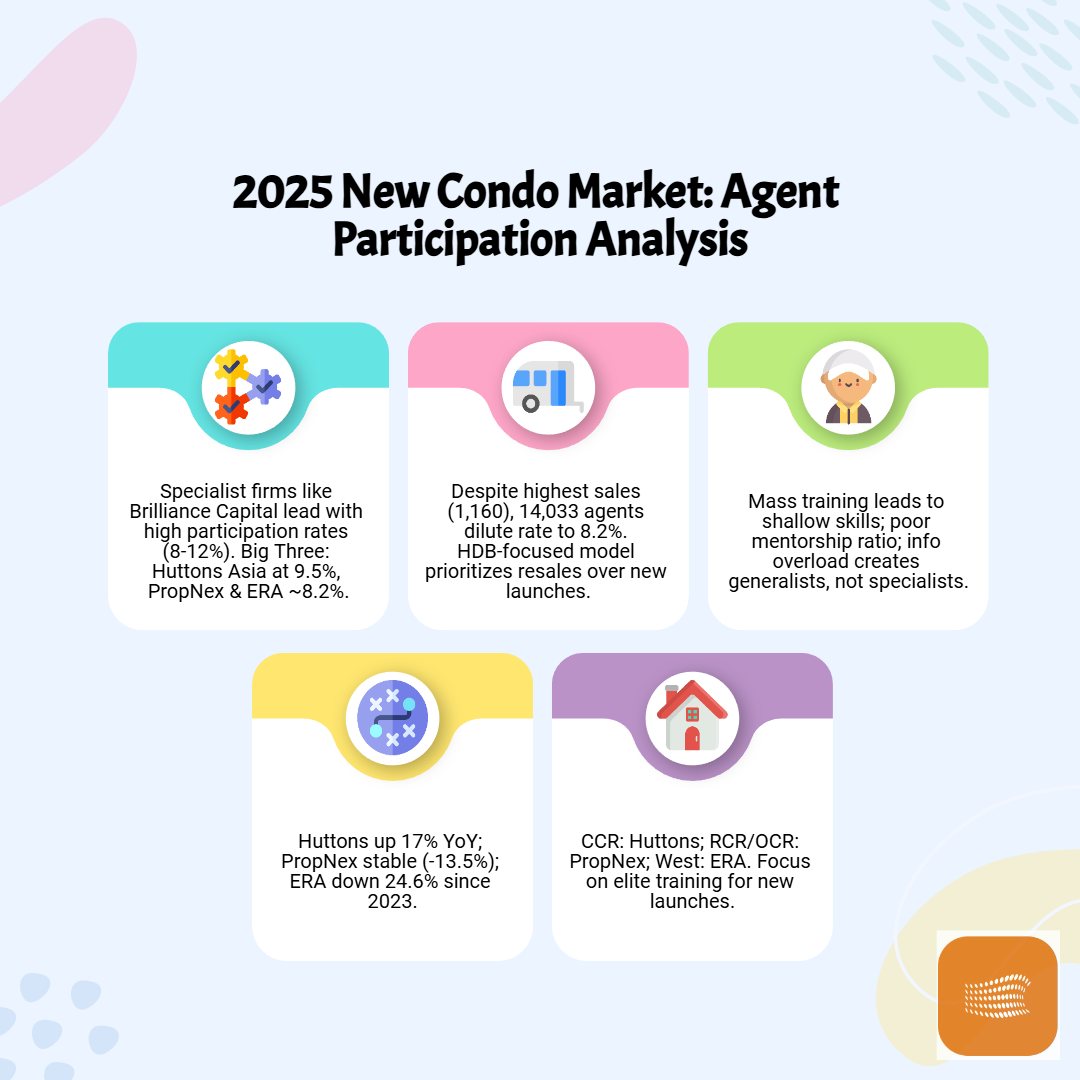
- Specialist Efficiency: Small, targeted firms like Brilliance Capital lead in participation, indicating a business model in which a higher density of their agents is active in the high-value new-launch segment.
- The "Big Three" Comparison: Among the largest agencies, Huttons Asia remains the most efficient, with nearly 9.5% of its agents closing a deal, followed by PropNex and ERA who maintain very similar participation levels (around 8.2%).
- The Elite Tier: The fact that the top participation rates remain around 8–12% even for the best-performing agencies underscores that the new condo market is a highly specialised "fighter's" arena, requiring specific expertise and focus that only a minority of the total agent population possesses.
The fact that the largest agency (PropNex) does not lead in participation rate—despite having the highest total sales volume—is a significant indicator of its underlying business model and the challenges of scale.
Based on the 2025 data, here is an analysis of why this gap exists and the potential negative implications regarding their training for new launches.
1. Why the Largest Agency Lags in Participation Rate
The "Denominator Effect"
PropNex has a massive base of 14,033 agents. In any large organisation, the "tail" is often long; a high percentage of these agents are likely to be part-timers, generalists, or specialists in other fields (such as HDB resales or industrial property). Because the participation rate is calculated as (Agents Who Sold) / (Total Agents)The sheer volume of non-specialised agents significantly drags down the percentage, even though PropNex has the highest absolute number of successful sellers (1,160).
HDB-First Business Model
As our previous analysis showed, PropNex dominates the HDB resale market with a 40.7% market share and a 20.05% participation rate. This indicates that the agency’s internal "gravity" pulls agents toward HDB resales. For many PropNex agents, HDB is the "bread and butter," while new launches are seen as a high-effort, low-certainty "bonus" sector.
Recruitment-Driven Growth
Largest agencies often prioritise recruitment (quantity) as a primary growth strategy. By bringing in thousands of new or inexperienced agents, they increase total volume through "mass coverage." However, many of these new recruits are not yet equipped to handle the complexities of a new condo launch, lowering the overall productivity percentage.
2. Negative Implications for Training in New Launches
When participation rates lag behind volume in a large-scale agency, it points to specific vulnerabilities in their training and developmental framework:
A. "Shotgun" vs. "Sniper" Training
- The Issue: Training in a 14,000-agent firm is often standardised and "mass-market." It is designed to be accessible to everyone, which can lead to a curriculum that is broad but shallow.
- The Implication: Agents may learn the "what" (project details, floor plans) but lack the "how" (high-level negotiation, investor-grade financial modeling, and developer tactical playbooks). This creates a workforce that can "show" a property but lacks the "closing" skills found in specialists at firms like Huttons.
B. Dilution of Mentorship
- The Issue: In a massive agency, the "Agent-to-Mentor" ratio is often skewed. The top 1% of producers (the "elites," who close 10+ new condos a year) are often too busy to effectively mentor the thousands of newcomers.
- The Implication: New agents are often left to "self-study" or follow generic online webinars. Without hands-on, tactical mentorship in the high-stakes environment of a showflat, these agents are less likely to convert leads, leading to the low participation rate we see.
C. Information Overload and "Generalist Fatigue"
- The Issue: PropNex agents are overwhelmed with training for HDB, Private Resale, Commercial, and dozens of New Launches simultaneously.
- The Implication: This creates "jack-of-all-trades, master of none" syndrome. When an agent is not specialised, they lack the confidence to push a new launch deal against a specialist "fighter" from a more focused firm. This results in agents "dropping out" of the new launch race after a few failed attempts.
D. Quality Control and Brand Consistency
- The Issue: With only 8.2% of agents successfully closing a new condo deal, the remaining 91.8% might still be representing the brand at showflats or in marketing.
- The Implication: This creates a high risk of inconsistent consumer experiences. A buyer might encounter a PropNex agent who is highly skilled, or one who is completely unfamiliar with the project’s nuances. This inconsistency can erode trust and lead buyers toward boutique agencies or specialist firms where they feel the agent is more "battle-hardened."
Strategic Conclusion
The data suggests that PropNex’s training is exceptionally effective at producing HDB specialists, but it struggles to convert its massive workforce into New Launch specialists.
For the largest agency to improve its participation rate, it would need to move away from "mass-enrollment" training and toward Elite Project Academies, separating its project-focused "fighters" from generalists to ensure specialised skills aren't diluted by the noise of the mass market.

Strategic Recommendation
- For CCR Sellers/Investors: Huttons Asia offers the most intensive specialization. Their data shows a higher success rate per agent in these prestigious districts.
- For RCR/OCR HDB Upgraders: PropNex provides the most comprehensive network to sell your current flat and transition into a city-fringe or suburban new launch.
- For Western Region Properties: ERA Realty remains a powerful contender with a strong historical foothold in the West.
While the "Big Three" dominate the Singapore market, their 2025 performance data reveals clear strategic "blind spots" and weaknesses in specific regions and segments.

Strategic Overview
- Huttons Asia is positioned as the "Specialist Sniper," focusing on high-value, low-volume districts where expertise is prioritised over headcount.
- PropNex is the "Mass Market Infantry," utilising its huge workforce to secure the largest share in the RCR and OCR.
- ERA serves as the "Versatile All-Rounder," though current data indicates they are being squeezed out of the primary market, leading to lower participation and CCR figures.
Momentum Findings & Strategic Implications

1. Huttons Asia: The "Rising Momentum" Winner
- The Trend: Huttons is the only agency among the top three to show consistent Year-on-Year (YoY) growth in the new condo segment. Between 2023 and 2025, they grew their volume by over 17%.
- Implication: Their specialized "fighter" strategy is working. By concentrating their smaller workforce on new launches, they are successfully capturing market share from the larger, more generalized firms.
- Momentum Score: High. They are closing the gap with PropNex and have already overtaken ERA for the #2 spot in new condo volume.
2. PropNex: Sustaining Dominance amid Friction
- The Trend: PropNex has seen a moderate decline (~13.5%) in new condo volume over the past 3 years.
- Implication: As the largest agency, they are more susceptible to broad market fluctuations. While they remain the #1 player by volume, their "market share" in the new launch segment is being nibbled away by specialised competitors like Huttons.
- Momentum Score: Stable. They remain the "Goliath," but their growth in the primary market is currently flat or slightly negative.
3. ERA Realty: Facing Significant Headwinds
- The Trend: ERA has experienced the steepest decline, with new condo sales down ~24.6% since 2023.
- Implication: This confirms our previous "Identity Crisis" analysis. ERA is losing its historical stronghold in the primary market, possibly due to top-producing agents migrating to firms with higher specialization or larger buyer networks.
- Momentum Score: Low. They are currently in a defensive position, needing a major strategic pivot to regain their share in project marketing.